
|
Checkers Rules |
|
|
| There are several varieties of Checkers. GameColony
offers you the most popular Anglo-American checkers. The rules are presented below. |
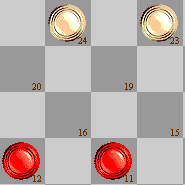
| Moves Starting with Red, the players take turns moving one of their own pieces. A
'piece' means either a 'man'--an ordinary single checker or a 'king' which is what a man
becomes if it reaches the last rank (see kings).
A man may move one square diagonally only forward--that is, toward the opponent--onto an
empty square. Thus, on the diagram on the right-hand side, the red pieces can move 12-16,
11-16 or 11-15. Similarly, the white pieces can move 24-20, 24-19 or 23-19. |
 |
|
|
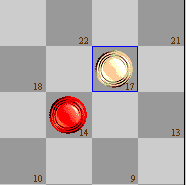
| Captures ('Jumps')
Captures or 'jumps' are mandatory. If a square diagonally in front
of a man is occupied by an opponent's piece, and if the square beyond that piece in the
same direction is empty, the man may 'jump' over the opponent's piece and land on the
empty square. The opponent's piece is captured and removed from the board. Thus, on the
diagram on the right-hand side red can 'jump' 14-21, leaving square (where white man
used to stand) 17 empty. Similarly, if it were white turn to move, the white man could
'jump' over its red counterpart 17-10, leaving square 14 empty.
If in the course of single or multiple jumps the man reaches the
last rank, becoming a king, the turn shifts to the opponent. No further 'continuation'
jump is possible |
 |
|
|
|
| The Kings When a single piece reaches the last rank of the board by reason of a move,
or as the completion of a 'jump', it becomes a king; and that completes the move, or
'jump'
A King can move in any direction and 'jump' in any direction one or
more pieces, as the limits of the board permit. The King can only jump diagonally over one
adjacent piece at a time, in any of the four diagonal directions. Multiple jumps are
possible. |
|
| |
Home | Checkers Basics | Checkers Rules | Play
Checkers | Contact Us | Links |
|
| |
|
|





